
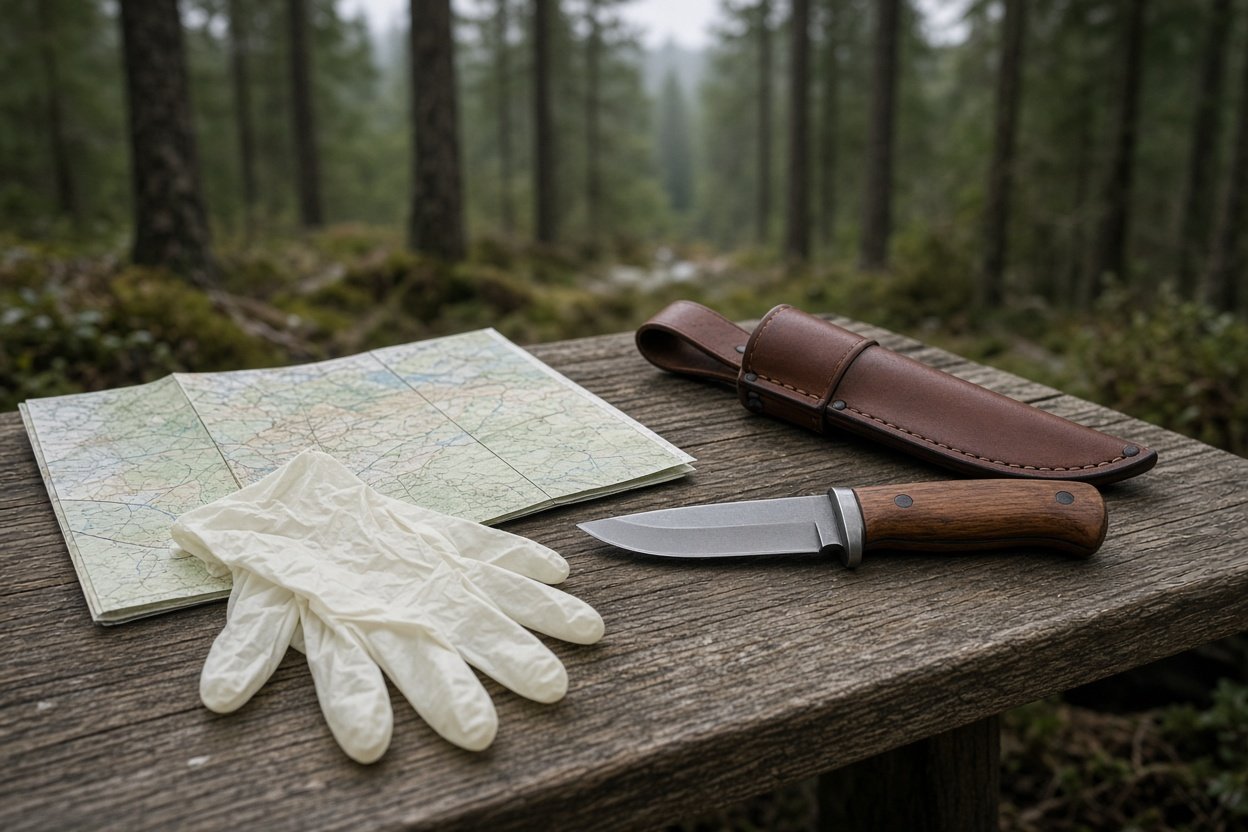
Best Hunting Knife: How to Choose the Right One
Best hunting knife: start with the job
The best starting point for most hunters is a fixed-blade drop point: it combines the strength and easy cleaning needed for field dressing with enough versatility for skinning and camp work. Choose a dedicated skinner when removing hide is the main task, or a folding knife when compact carry matters more than maximum robustness. Construction, blade shape, maintenance and transport rules matter more than a fashionable name.
Hunting knives are commonly used for field dressing, skinning, caping and general camp work. Field dressing means opening and preparing an animal soon after the kill; caping is the careful removal of the hide around the head and neck. Compare the knife’s construction and blade design with that main job.
| If your main task is | Start with | Why |
|---|---|---|
| Field dressing and general use | Fixed-blade drop point | Strong, simple to clean and suitable for several jobs |
| Removing hide efficiently | Dedicated skinner | Designed around skinning rather than general cutting |
| Small, careful cuts around the head | Caping knife | Better suited to controlled detail work |
| Compact carry and occasional use | Folding knife | Folds smaller than a fixed blade |
| Longer trips with camp chores | General-purpose fixed blade | Useful for hunting tasks and camp work |
A fixed-blade hunting knife has no moving parts. It is generally presented as stronger, easier to clean and more reliable than a folding knife for field dressing, skinning and camp use. A folder can be convenient when pack space is limited, but its joint and locking mechanism need more attention after wet or dirty work. The basic fixed-blade comparison is explained in this fixed-blade hunting knife guide.
Best fixed-blade hunting knife for field dressing
Choose a fixed-blade drop point when you want one knife to cover field dressing, skinning and camp tasks. The fixed construction gives the knife a simple, robust format, while a drop-point profile provides a practical general-purpose shape. Typical hunting fixed blades are described as having blades of approximately 3.5–6 inches, giving a useful range from compact control to broader cutting ability.
For field dressing, look for a blade that is easy to rinse and wipe clean, a handle that remains secure in the hand, and a sheath that protects the edge when the knife is not being used. A very specialised blade can perform one operation well but be less convenient when you need to make several different cuts.
Field dressing involves contact with moisture, tissue and debris, so cleaning is part of the knife choice. The simpler the construction, the fewer recesses there are to inspect. That is one practical reason fixed blades are often preferred for this work.
Best hunting knife for skinning and caping
Choose a skinner when removing hide is the main job, and choose a caping knife when precision around the head is more important. A skinner is a specialist hunting knife designed around hide removal; it should not automatically be treated as the best all-round camp knife. A caping knife is aimed at controlled, detailed cuts and may be paired with a more general blade.
For a single-knife kit, a general-purpose fixed blade is usually the more flexible choice. For a hunter who regularly prioritises hide removal or trophy preparation, a specialist blade can make more sense. The decision depends on whether you value versatility or a design focused on one operation.
Gut-hook knives are another specialist option. A gut hook is a sharpened or hooked feature intended for a particular opening cut. It may appeal to hunters who want that dedicated function, but it adds another part of the blade to clean and maintain. Compare it with a plain drop point rather than assuming that more features mean better performance.
Blade shapes: drop point, clip point and skinner
Drop point, clip point and skinner are the main blade shapes to compare first. The shape changes the position of the point, the amount of cutting edge and the way the knife handles controlled work. A drop point is the broadest starting point for a general hunting knife; a skinner is more task-specific; a clip point suits work where a finer point is useful.
| Blade shape | Best starting use | What to consider |
|---|---|---|
| Drop point | Field dressing and general hunting work | Balanced choice for a one-knife kit |
| Skinner | Removing hide | Specialist design with less emphasis on general camp use |
| Clip point | Controlled cuts where a finer point helps | Consider whether the finer point suits your main task |
Blade length should support control rather than simply maximise cutting edge. The commonly described range of approximately 3.5–6 inches covers compact hunting fixed blades through to larger options. Select the size that gives you enough working edge while remaining comfortable for detailed cuts.
Top hunting knife models by category
There is no single model that is best for every hunter. The table below groups named recommendations by the category assigned to them by the relevant guide.
| Model | Category or use | Source’s description |
|---|---|---|
| Montana Knife Company Blackfoot 2.0 | Fixed blade; skinning | Field & Stream names it its best fixed blade; HuntWise recommends it for skinning hides |
| Benchmade Hidden Canyon Hunter | Fixed blade | HuntWise’s best overall fixed-blade option |
| GiantMouse Ace Jutland | Folding knife | Field & Stream’s best folding knife |
| Gerber Downwind Drop Point | Lower-price category | Field & Stream’s best knife under US$100 |
| Opinel No. 08 Carbon | Budget knife | Field & Stream’s best budget knife |
| Buck 102 Woodsman | All-round hunting knife | HuntWise’s all-round hunting recommendation |
| Argali Sawtooth | Lightweight option | HuntWise’s lightweight recommendation |
| Buck 662 Alpha Scout Select | Budget blade | HuntWise’s budget recommendation |
| Gerber Exo-Mod Drop Point Fixed | Budget alternative | HuntWise’s budget runner-up |
Field & Stream’s tested selection covers fixed blades, folders and budget categories, while HuntWise’s hunting-knife recommendations separates all-round, lightweight, skinning and budget uses. Field & Stream describes its selection as ranging from approximately US$20 folders to US$300 skinners. Those are US-dollar category references rather than UK retail prices, so they show the spread between budget and premium knives rather than serving as a UK shopping list.
Best knife hunting for the money
For value, choose the simplest knife that performs your main task well. A plain fixed blade may offer more practical flexibility than paying for a specialist feature you rarely use. If compact carry is more important than maximum robustness, a folding knife may be the better value for your particular trips.
The named budget categories give several starting points: Field & Stream names the Gerber Downwind Drop Point as its best knife under US$100 and the Opinel No. 08 Carbon as its best budget knife. HuntWise lists the Buck 662 Alpha Scout Select as a budget blade and the Gerber Exo-Mod Drop Point Fixed as a budget runner-up. Compare the construction and intended use before comparing the label “budget”.
Blade steel, handle and sheath
Choose steel and handle materials according to maintenance and grip, not only edge retention. A knife used for field dressing needs to be cleaned promptly and stored dry. A handle should remain controllable when your hands are wet or when you are wearing gloves. The sheath should retain the knife securely and protect the edge during transport.
“Edge retention” means how long an edge stays usable before sharpening; “toughness” refers to resistance to chipping or breakage. These qualities can pull in different directions, so there is no universal best steel for every hunting knife. A very hard edge may appeal to someone who wants fewer sharpening sessions, while a hunter who works far from equipment may prioritise easy field maintenance.
Before buying, check four practical details:
- Can you clean the blade and handle thoroughly after field dressing?
- Does the handle give you a secure grip for controlled cuts?
- Does the sheath protect the blade and keep it secure?
- Can you sharpen and maintain the knife during the trip?
Fixed blade or folding hunting knife?
Choose a fixed blade for strength, straightforward cleaning and repeated field use. Choose a folder when compact storage and reduced bulk are the priority. The choice is a trade-off between simplicity and portability.
| Feature | Fixed blade | Folding knife |
|---|---|---|
| Construction | No moving parts | Blade folds into the handle |
| Field dressing | Strong and easy to clean | Compact, but needs attention around the mechanism |
| Camp use | Well suited to repeated general work | Useful when pack space matters |
| Best starting buyer | Hunter prioritising reliability and easy cleaning | Hunter prioritising compact carry |
For a first hunting knife, a fixed-blade drop point is the clearest general-purpose starting point. Add a specialist skinner or caping knife only when that particular task justifies carrying another tool.
UK knife law and transporting a hunting knife
Owning a hunting knife and carrying one in a public place are separate issues in the UK. The UK government states that carrying most knives or weapons in public without a “good reason” is illegal. Work-related use is given as one possible example, but a court decides whether the reason is valid in an individual case.
The general exception covers a folding pocket knife with a cutting edge no longer than 3 inches and no locking mechanism. It does not generally cover an ordinary fixed-blade hunting knife. The Crown Prosecution Service also states that possession of a bladed article in a public place can be an offence unless there is good reason or lawful authority.
For a hunting trip, keep the knife connected to the journey and activity, transport it safely, and avoid carrying it casually in public. Do not assume that describing a knife as work equipment automatically settles the question: the circumstances and the immediate connection between the knife and the work matter. The UK government’s knife guidance explains the public-carrying rules and the banned-weapon restrictions.
Banned knives are illegal to possess, bring into the UK, sell, hire out, lend or give away, subject to limited exemptions. An adult convicted of illegally carrying a knife or weapon can face up to four years’ imprisonment, an unlimited fine, or both.
How to choose your knife before a Swedish hunting trip
Make the choice in this order: task, construction, blade shape, size, maintenance and transport. This prevents a famous model or attractive specification from deciding the purchase for you.
- Write down the main job. Choose field dressing, skinning, caping or general camp work.
- Choose fixed or folding construction. Favour a fixed blade for repeated dirty work; favour a folder when compactness matters most.
- Select the blade shape. Start with drop point for general use, skinner for hide removal or clip point for more controlled pointed work.
- Check size and grip. Keep the knife controllable and within the approximately 3.5–6-inch range commonly described for hunting fixed blades unless your use gives you a clear reason to choose differently.
- Plan cleaning and sharpening. Take the maintenance method you can actually use during the trip.
- Plan the journey. Keep the knife secured and connected to the hunting activity during transport.
For field dressing, choose a fixed-blade drop point; for dedicated hide removal, choose a skinner; when compact carry is the priority, choose a folder.
Frequently asked questions
What is the best hunting knife in the UK?
A fixed-blade drop point is the best all-round starting point for field dressing, skinning and camp work. A skinner is a better choice when hide removal is the main task, while a folder is better when compact carry is the priority. Choose the design that matches the work and transport it in accordance with UK rules.
Is it illegal to own a hunting knife in the UK?
Not every hunting knife is illegal to own. Certain banned knives cannot lawfully be possessed, while carrying most knives in a public place requires a good reason or lawful authority. A fixed-blade hunting knife is not covered by the usual exception for a small, non-locking folding pocket knife, so ownership and public transport should be treated as separate questions.