
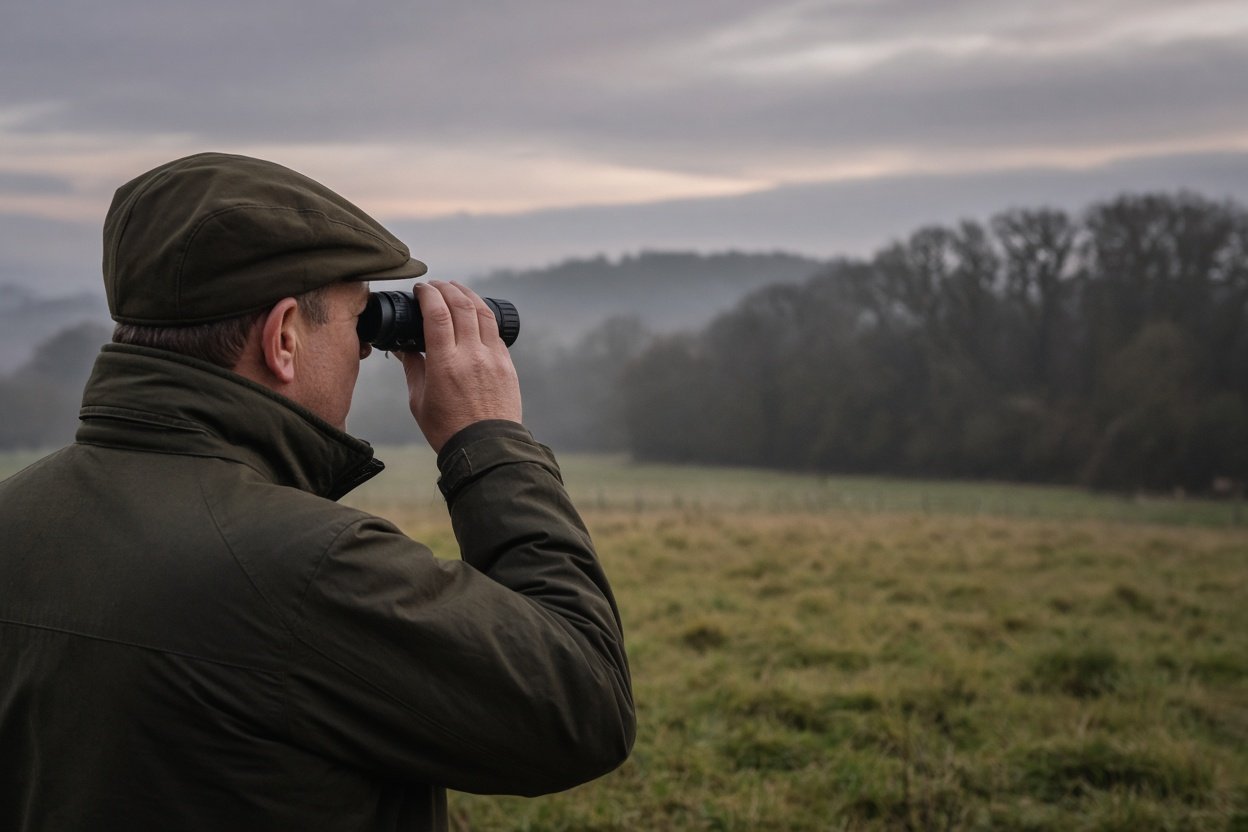
Thermal Spotting Scope for Hunting: UK Buyer’s Guide
Thermal spotting scope for hunting: the essentials
A thermal spotting scope is a handheld thermal monocular used to detect and observe animals by their heat signature. It is useful for wildlife observation, foxing, vermin control and deer management, particularly when visible light is poor. Current UK retail options range from the HIKMICRO Lynx 3.0 LE10 at £399.99 to premium models costing several thousand pounds.
The main buying decision is whether you need a handheld thermal spotter for observation or a thermal rifle scope for aiming. A monocular stays in your hand and helps you scan, identify and assess an area. A rifle scope or front attachment is mounted to a firearm and is intended for aiming. This guide focuses mainly on handheld thermal imaging monoculars for spotting.
Thermal monocular prices in the UK
The following models and prices are listed by Scott Country. They show the range from entry-level handheld thermal imagers to premium units.
| Model | Type | Listed price | Position in the range |
|---|---|---|---|
| HIKMICRO Lynx 3.0 LE10 | Thermal monocular | £399.99 | Entry-level handheld spotting |
| HIKMICRO Lynx 3.0 LE15 | Thermal monocular | £549.99 | Lower-cost field use |
| NocPix Lumi P13 | Thermal monocular | £469.00 | Lower-cost thermal observation |
| HIKMICRO Lynx 3.0 LH15 | Handheld thermal imager | £799.99 | Mid-range handheld use |
| Pulsar Axion XQ19 | Handheld thermal imager | £879.95 | Compact Pulsar option |
| HIKMICRO Lynx 3.0 LH19 | Thermal monocular | £899.99 | Longer-range observation |
| Pulsar Axion XQ30 PRO | Handheld thermal monocular | £1,079.95 | Higher-priced compact spotting |
| Pulsar Telos XP50 | Handheld thermal imager | £2,429.95 | Premium thermal observation |
| Pulsar Telos XL50 | Handheld thermal imager | £3,329.95 | Top-end handheld use |
These are current product listings rather than a universal market price; the retailer’s range is the reference for the figures above. Scott Country also lists HIKMICRO, Pulsar and NocPix models across a wider range of specifications and prices.
What is a thermal spotter?
A thermal spotter is a handheld camera that detects infrared radiation from warm objects and displays a heat-based image. British retailers use “thermal monocular”, “thermal spotter” and “hand-held thermal imager” for broadly the same type of product. Unlike a conventional optical scope, it does not depend on visible light.
A handheld thermal monocular can therefore be used in daylight, low light and complete darkness. Scott Country also describes thermal imaging as useful in fog, rain, snow, dense vegetation and long grass, where traditional night vision may struggle to create an image.
A thermal spotter is useful when you want to scan an area without pointing a firearm at it. It can help locate a warm animal, observe movement and decide whether closer identification is needed. A rifle-mounted thermal sight has a different role.
HIKMICRO thermal monocular or Pulsar thermal monocular?
HIKMICRO and Pulsar are both represented in the UK handheld market. HIKMICRO offers lower-priced entry points in the listed range, while Pulsar’s catalogue includes compact Axion models and higher-priced Telos units. The right choice depends on the observation task, optical specification and budget rather than the brand alone.
| Brand and range | Examples in the UK listings | Price span shown here | Range characteristics |
|---|---|---|---|
| HIKMICRO Lynx 3.0 | LE10, LE15, LH15, LH19, LH25, LH35 | £399.99–£1,149.99 | Stepped prices and focal-length options |
| Pulsar Axion | XQ19 and XQ30 PRO | £879.95–£1,079.95 | Compact handheld thermal models |
| Pulsar Telos | XQ35, XP50, LRF XP50 and XL50 | £1,259.95–£3,329.95 | Higher-priced handheld models |
| NocPix Lumi and Vista | Lumi P13, Lumi L19, Vista H50R and Vista S50R | £469.00–£3,999.99 | Entry-level through premium alternatives |
The LE10 and LE15 are the lowest-priced HIKMICRO options in this comparison. The Pulsar Axion XQ19 is the lowest-priced Pulsar model shown. Premium options include the Telos and NocPix Vista ranges, although price alone does not determine which model suits a particular field or species.
How to choose the best thermal monocular
Choose the model by matching its sensor, lens and viewing characteristics to the distance and terrain where you will use it. The main specifications are sensor resolution, pixel pitch, NETD, lens size, field of view and detection range.
- Sensor resolution: a higher-resolution sensor can provide more image information, particularly when the animal is farther away or you need to assess shape and detail.
- Pixel pitch: this describes the spacing between sensor pixels, usually in micrometres. It appears in the technical requirements for some authorised night-shooting equipment.
- NETD: this measures thermal sensitivity in millikelvins. A lower NETD indicates that the sensor can distinguish smaller temperature differences.
- Lens and focal length: a larger or longer lens can support more distant observation, while a wider view makes scanning woodland edges, fields and close cover easier.
- Field of view: a wide field helps you find moving animals quickly; a narrower field can suit concentration on a distant area.
- Detection range: this is the distance at which a heat source may be detected, not a guarantee that you will identify a species at that distance.
- Recording and connectivity: some models offer video recording and Wi-Fi streaming for reviewing observations or sharing a view.
Scott Country describes the HIKMICRO Lynx 3.0 LH19 3.0 Pro with a detection range of up to 700 metres, less than 15 mK NETD, a 12-micrometre sensor, built-in Wi-Fi and recording. The quoted detection range is a product specification, not the distance at which every animal will be recognisable.
Best budget thermal monocular UK options
The lowest-priced handheld options in the listed UK range are the HIKMICRO Lynx 3.0 LE10 at £399.99, the NocPix Lumi P13 at £469.00 and the HIKMICRO Lynx 3.0 LE15 at £549.99. For a budget thermal spotter, decide whether you need basic detection at shorter distances or a more capable image for detailed observation.
The LE10 is the lowest-priced model in this comparison. The NocPix Lumi P13 is another relatively inexpensive route into handheld thermal imaging. If you prefer Pulsar, the Axion XQ19 is listed at £879.95, placing it above these entry-level choices. These prices concern handheld spotters rather than rifle-mounted sights.
A cheap thermal monocular can still be useful for finding a heat source in darkness. Judge it by the lens, sensor, field of view, battery arrangement, weather resistance, controls and return terms, as well as its price. A listed detection range does not equal reliable identification in rain, vegetation or uneven terrain.
Thermal monocular versus thermal rifle scope
Use a thermal monocular when your main task is observation. Use a thermal rifle scope or front attachment for aiming only when the equipment, firearm, quarry, land permission and applicable law support that use.
| Feature | Handheld thermal monocular | Thermal rifle scope or front attachment |
|---|---|---|
| Primary purpose | Scanning, detection and observation | Aiming and sighting when permitted |
| Mounting | Carried in the hand | Mounted to or in front of a rifle sight |
| Use in the field | Assess an area without pointing a firearm | Requires control of the muzzle and target |
| Legal considerations | Subject to hunting and firearms rules where relevant | May be restricted by quarry, licence and equipment conditions |
Heat signatures can be obscured by vegetation. Confirm the target and the backstop before any decision to shoot.
Are thermal scopes legal in the UK?
In England, Natural England’s CL55 covers night shooting of deer under specified conditions and purposes. It permits certain dedicated digital thermal riflescopes and front attachments under the licence when they meet stated minimum requirements, including 640 × 480 sensor resolution, a pixel pitch of no more than 17 micrometres, a focal length of at least 50 mm and a frame rate of at least 50 Hz.
CL55 applies from one hour after sunset to one hour before sunrise. It also requires the relevant local police and firearms licensing authority to be informed at least 24 hours before night shooting. The licence includes requirements concerning knowledge of night-shooting aids, including thermal imaging equipment.
GOV.UK states that hunting and shooting must comply with rules covering the species, timing and equipment, and that landowner permission is required. Firearms certificates may also be required in England, subject to the stated airgun exceptions. GOV.UK’s hunting guidance sets out the wider requirements.
For bird shooting, GOV.UK states that sighting devices for night shooting, or equipment used to illuminate targets, must not be used. Read the detailed CL55 licence conditions before using a thermal rifle-scope setup in England.
What are the downsides of thermal imaging?
Thermal imaging cannot see through walls, glass, mirrors or water, and reflective surfaces can produce misleading readings. A warm-looking shape is not automatically a clearly identified animal.
Thermal equipment shows temperature contrast rather than the familiar detail of ordinary daylight vision. Heavy rain, dense cover and changing surface temperatures can make interpretation harder. Detection, recognition and identification are different tasks: spotting a heat source is easier than deciding exactly what it is.
Can a smartphone be used as a thermal camera?
Yes, but a normal smartphone needs a dedicated attachment such as FLIR ONE. FLIR ONE is available for iOS and Android phones, with USB-C or Lightning connections depending on the telephone.
A smartphone attachment can be practical for basic thermal viewing, building checks and occasional observation. It is not a purpose-built hunting monocular. Its intended usefulness depends on the field conditions, viewing distance and handling required. See the FLIR ONE product information and phone compatibility guidance.
How to buy a thermal spotting scope
- Define the job: decide whether you need wildlife observation, vermin control, foxing, deer management or occasional scanning.
- Set a budget: compare entry-level HIKMICRO and NocPix models with the more expensive Pulsar and premium units.
- Match the field of view: choose wider viewing for scanning close cover and longer focal lengths for more distant observation.
- Compare the sensor: review resolution, pixel pitch and NETD together rather than selecting on one number.
- Assess practical handling: consider controls, battery arrangements, recording, Wi-Fi, weather protection and weight.
- Confirm the rules: check the country, quarry, season, land permission, firearms requirements and licence conditions before use.
For many hunters, a handheld thermal monocular is a flexible first purchase because it supports detection and observation without being attached to a firearm. Select the optical specification for the terrain and distance you expect to encounter.
Frequently asked questions
What is the best thermal monocular in the UK?
The best choice depends on the required distance, field of view, sensor specification and budget. The listed entry-level choices include the HIKMICRO Lynx 3.0 LE10 and NocPix Lumi P13, while Pulsar Axion and Telos models cover higher price bands.
What is the best budget thermal scope in the UK?
For handheld thermal spotting, the lowest listed price is the HIKMICRO Lynx 3.0 LE10 at £399.99, followed by the NocPix Lumi P13 at £469.00. These are thermal monoculars for observation rather than rifle-mounted sights.
What is the difference between a thermal spotter and a thermal scope?
A thermal spotter is normally a handheld device for scanning and observation. A thermal scope is generally designed to be mounted for aiming. Retailers sometimes use the terms loosely, so the mounting system and intended use are important.
Can I use a thermal monocular in daylight?
Yes. Handheld thermal monoculars detect heat rather than relying on visible light, so they can be used in daylight, low light and complete darkness.